Integrated Maximus Communications

It’s human nature to feel the urge to be in control, though we know this is not always achievable. Whether it’s beers at the pub, working on a group assignment, the Tigers efforts against the Pies in the preliminary final, eating pizza shapes, or managing  marketing campaigns we know that often a firm grasp can fade away and our guard can be let down. So in terms of word of mouth and general consumer perception of an IMC campaign, how do we manage the loss of control? It’s a scary prospect and totally goes against all traditional business processes but the loss of control these days often needs to be accepted, embraced and supported.

According to (Mangold,W.G & Faulds. D.J, (2009) the most effective way of supporting the relinquishment of control is through attempting to ‘shape the discussion’ and can be narrowed to a handy 9 step guide.
1. Provide networking platforms
2. Use blogs and other social media tools to engage customers (encourage feedback from customers)
3. Use both traditional and internet-based promotional tools
4. Provide information
5. Be outrageous
6. Provide exclusivity
7. Design products with talking points in mind (viral)
8. Support causes that are important to customers (build emotional connections)
9. Utilise the power of stories

An example of how this has all been acknowledged and implemented is by the ‘sports drink’ Maximus, who chose to undertake an entirely new branding strategy due to consumer behaviour and word of mouth of their product.
Maximus was initially positioned to take on sports drink giants such as Gatorade and Powerade with a product focus by bettering them on fluid replenishment and superior hydration with a super-hydrating litre bottle. But long before Maximus acknowledged it in their advertising it was a well-established tradition to buy a Maximus to have on a Sunday morning on the recovery from a boozy Saturday night. So Maximus listened and acted. It became clear that Gatorade is the Coca-cola of sports drinks so Maximus succumbed and has since introduced a confident, edgy and arguably crass IMC structure which has reaped unforeseeable benefits.
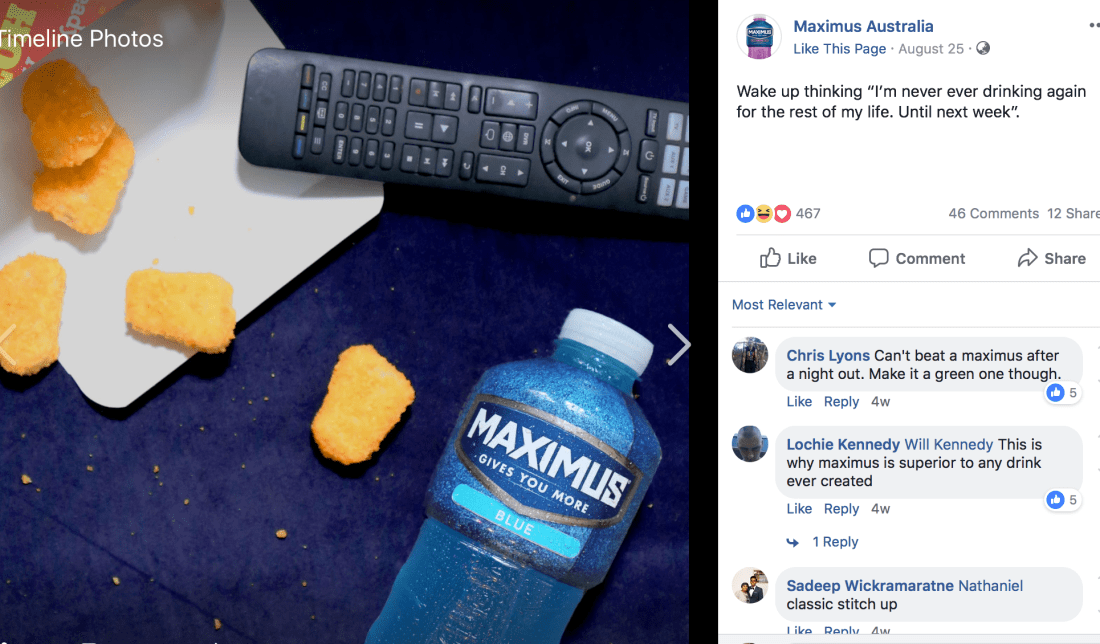
Screen Shot 2018-09-25 at 2.39.59 PM

People loved it. Of course, By people I mean males aged 16-31 loved it, So this lead to similar posts.

40326732_2202359869805624_8218027743137234944_o

Maximus’ focus on being an essential hangover fix and inserting itself into the culture of young blokes getting hammered of course inevitably led to more suggestive and questionable IMC antics.
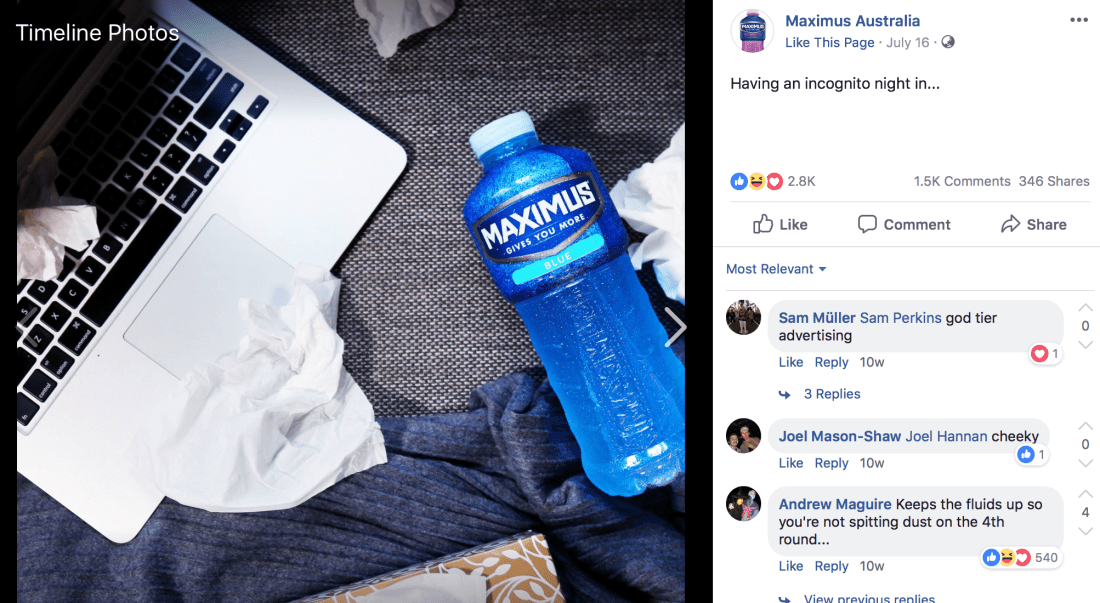
Screen Shot 2018-09-25 at 2.41.12 PM

If we refer back to the 9 step guide mentioned earlier, and we look at in particular
5. Be outrageous
and
7. Design products with talking points in mind
No Australian IMC effort has been ballsier than this one, arguably showing recognition and support of the use of their product for home-made bongs which supports an illicit drug culture amongst Young men.

38851695_2021047884572905_4502074239670550528_o

But if you read this article and look at the way Maximus have ‘shaped the discussion’ in the comment section replying to consumers, you can see that their efforts in terms of campaign success have done more good than harm. This is a prime example of how embracing word of mouth and consumer perception can be flipped and shaped to create a wealth of business success in a contemporary and effective fashion.

What other examples can you guys recall of other products who have totally rebranded and repositioned their products IMC strategy in support of arguably a negative e-word of mouth?

Jake Herman
Privacy Hipsters

The Internet of things and big data oh my, what a revolution. The enhanced knowledge and plethora of information of the everyday average Joe is at incomprehensible heights and the breadth of daily-technology which engulfs us only adds to this. The Internet of things is defined as ‘the pervasive presence of a variety of devices such as sensors, actuators and mobile phones which, through unique addressing schemes, are able to interact and co-operate with each other to reach common goals (Giusto, 2010). The prevalence of wearable technology in particular is a trend which allows for such heightened data collection to exist. Fitbits, Apple Watches, Google Glasses etc etc are literally tracking everything from what we eat to our exercise and more. I’m sure I’m not the only one who was shocked to learn that there is even an option to enter your sexual activity information in real-time on your iPhone app titled ‘Health’. The often unintentional allowance of intrusion into our lives has resulted in uproar and general concern which has unsurprisingly lead to boycotts of these programs or applications which some feel are too close to home. But what are the implications for the ‘unconnected’ and ‘disenfranchised’ going forward?

For those that have decided to rebel against the privacy invaders and cut-off their ties, what is the impact? Can we ever truely disconnect ourselves from the world and its peering eye? It can be spoken about for hours in a variety of ways from an even larger variety of standpoints but I think that the answer is it’s just a fad. Our information has been collected forever one way or another so why do we bother wasting breath, time and energy disputing it? The paranoid reader will rebut with “you’re giving up in the fight, thats what they want you to do, you’re letting them win”. Perhaps, this is true but there is solace in the acceptance of knowing it’s a battle not worth fighting.

giphy

I have a friend who I was very close to throughout high-school and our first year of University. It was only until year two at University when he was fortunate enough to secure an internship when he decided to delete all social platforms from his life so he could solely “chase the money and not be disturbed by anything”. As admirably ambitious as it was, I then began to see a demise in his personality and general view towards life which became a toxic, unbecoming facade of disengagement with reality. At the risk of sounding like a nerd, he reminded me of the erratic and disconnected Trevor from this dialogue in Grand Theft Auto 5. Neither myself or anyone else from our social circles have seen him in over a year despite our attempts to reconnect, leading to others harsh comments and a general shut-out of our once great friend. As extreme as this end of the scale may be and how social interaction is indeed an effective distraction, I think its a point worth mentioning. I’m more introverted than extroverted but still love having a yarn with mates over whatever it may be. The argument for social interaction, communication and belongingness or acceptance being a part of human nature isn’t ignorable and needs to be considered prior to the trashing of social avenues altogether amidst the defence against the Internet of things for baseless or outlandish reasons.

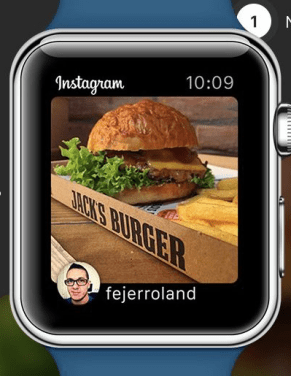
The Internet of things and the wonderful technology that is involved with it is certainly a marvel worth savouring and applying to useful projects. As an aspiring marketer, I treat the evident collection of my information to create marketing strategies tailored straight to me as an amazing revelation in the industry. One that outweighs the negative perception adopted by the my consumer side. When it’s all said and done, YOU make the final decision of whether to purchase or not. Just because we may think about having a burger for lunch and then subsequently see an ad on Instagram on our Apple Watch for a Burger does not mean we are obligated to go indulge in one. Actually come to think of it, I could go for one now…

apple watch ad !

Ads… Bloody Ads

The present day state of attachment between the majority of people to their mobile phones is staggeringly normalised and understandable. Those vibrating rectangles in our pockets are worth more than just the $1000+ we all forked out for them. They are our primary gateway to communication with loved ones and loved things and don’t we just love to love them. This is a trend which has been cementing itself into our world for a while now and Marketer’s have caught on accordingly. You can now seldom visit a mobile site of any nature without being bombarded by banners,  PPC or in-game advertising which detract, annoy and frustrate us more often than not.


jerry

So time goes on, ad’s become more prevalent and intrusive. We’re spending 30 seconds watching an ad before we’re allowed to watch a 25 second Youtube video. It’s not making sense. But then, shrouded in a cloud of promotional clutter, a bright idea is devised in which you can now pay to not see these ad’s. Imagine pouring all of yourself into a piece of artwork and having it in a gallery amongst the other masterpieces, only for impatient gallery attendee’s to drop a handful of change into a bucket nearby simply to not view it. A ZDNet article from June last year revealed that 615 Million or 11% of all internet users are currently running an ad-blocking service on their computers. For your everyday time-poor mobile-engrossed consumer, it seems like a gift from the gods being able to pay away these pesky pop-ups. But what kind of detrimental affect will it have for Marketers?

giphy

However, the power of the mobile user reaches further than just being able to deflect advertisement’s. The emergence of and dependence on our mobile phones is helping shift us all toward a cashless society whether we like it or not. ApplePay and WeChat are only a couple of ways we can now transfer our hard earned money to one-another without stretching the leather in our wallets. If our phone’s can permanently shift the face of monetary exchange and abolish the use of cash forever because thats whats in demand, then what future does mobile/digital marketing have in a world we can bribe away advertising?

Alexander Graham Bell would be rolling in his grave.


Jake Herman

Marketing Magnificence Made By McCANN

Perhaps the best and most successful viral marketing sensation of all time all began right here in Melbourne. On behalf of the client Metro Trains, The most infamous Creative agency in the world McCANN Erickson delivered a super catchy song which today has polled over 169 Million views on Youtube. The vibrant music video highlighted what we know as ‘Dumb ways to die’ with cartoons in a fun and lighthearted way, which also cleverly illustrated the importance of remaining alert and safe around trains.

You would imagine that Metro Trains would have felt like they well and truly got their moneys worth from the investment, but what McCANN did next was unprecedented and truly genius. They created a mini-game style app captured the worlds attention and devotion.

dumb

A McCANN representative said “Music was great, but it had a limited lifespan. We needed to not just attract people’s attention, but also encourage ongoing engagement”. Create ongoing engagement they did, with the game boasting 67 million downloads, reaching number 1 on iPad charts in 85 countries and most amazingly 5.7 Billion gameplay sessions.

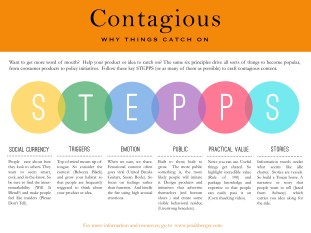
2012 was a time when it could be argued that interest of playing app’s on your phone or iPad was at its very peak. But aside from the glorious timing being a coincidental factor in the song/games success, the core message that was the undertone of the playful campaign was delivered just perfectly. In regards to Jonah Berger’s STEPPS model, all aspects are covered.

stepps
Leveraging game mechanics through social currency, a strong association between the brand/message and the media vehicle used as a trigger, Positive/ high arousal which spark real emotions, public social proof and practical value all wrapped up in one perfect little story. Though not all elements of Jonah Berger’s STEPPS need to be addressed for a successful viral marketing campaign, McCANN Erickson were able to do so and it reaped unforeseen benefits, promoting worldwide public transport safety on behalf of Melbourne’s Metro Train’s, while creating a robust relationship between the user and generator of the message.


Jake Herman

Pareto Is Dead!

For contemporary and emerging businesses, the Pareto principle is taking a backseat to other more current ideas of serving customers. The Long Tail theory of Chris Anderson outlines the emerging trend of serving niche markets, cultivating unique consumer experiences and bizarre products. Cold drip coffee, Eating food in the dark, Fidget Spinners, outrageous fashion and face tattoos and listening to alternative music types. These are only naming a few, so why did these trends or fads become cultural phenomenons?

The quest for individuality amongst the everyday person is becoming increasingly difficult. The social pressures and influence we are confronted with on an hourly basis via social media is unwavering and deadly. Everybody is trying to out-do the next person and tell another 5 people about it. With reference to the Facebook Segmentation Matrix (Hodis, 2015) I believe we are all subconsciously ‘Attention Seekers’ with the end goal of creating an external perception of being unique or dancing to the beat of our own drum, not that it always works.

The wave of social media which has eternally entrenched itself into the worlds society has dictated that individuality can easily be expressed through materialistic goods or experiences. Businesses have tapped into this cultural perspective too, and can now charge premium price points for such things –

Smashed Avocado on Toast with an Acai smoothie – $36

“Yeah, no worries”

Smashed-avocado-v2-LGH-568ba110-4d9e-4023-a2bd-5ffd7528e72a-0-1400x919

But is it really individuality if we all succumb to these well-marketed products and throw them on our body or into our stomachs? They are niche fads and products with the promise of standing out from the crowd, but the last time I checked, the Adidas Stan Smith’s were as common as having real eyebrows. Which I suppose can create comfort for some of the consumers of these shoes as they are ‘fitting in’.

This trend of seeking the niche or whats unique is not something that will deteriorate. Individuality is idealised by many and serviced by marketers in a variety of ways, through a variety of products. In This sense the Pareto Principle is still alive. 80% desire it, 20% achieve it.

 
Jake Herman